Like this a lot, but it needs more blood

Shirt of the week [Destructoid]
Google Blogger now not Beta, I hope this means they won’t now screw up the blogs of people that transfer to the new service. I’ve had to try to help a few people that have had that problem, and it ain’t no fun – flotsky
Google Blogger has officially left its beta tag behind. Google bought Pyra Labs in 2003 and introduce the beta version of "Blogger" last August. The Blogger web site now introduces "the new Blogger" on its main page. The new interface offers drag-and-drop template customization, permissions features for priavet blog entries, additional RSS feed options, the ability to tag posts with keywords, an updated Blogger dashboard and instant publishing. Some, but not all, bloggers that signed up before November 10 can transfer over to the "new Blogger" without losing their blogs after they sign in under the "Old Blogger" page.
 View: Google Blogger
 News source: Ars Technica
From Boing Boing, some links to some fantastic cartoons
Xeni Jardin:
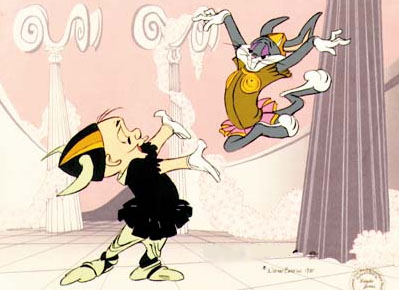
Cityrag has compiled video links for a list of The 50 Greatest Cartoons as voted on by the animation industry in 1994. Here's an excerpt:
1. What's Opera, Doc? (1957)
2. Duck Amuck (1953)
3. The Band Concert (1935)
4. Duck Dodgers in the 24½th Century (1953)5. One Froggy Evening (1956)
The complete list is here, and it's absolutely awesome: Link.
I’m finding myself increasingly troubled about the way in which the investigation of the multiple murders in Ipswich is progressing. Not in terms of what the police are doing, but the way in which the media is leading its own investigation in parallel, and in public. Yesterday a man was arrested. He has been questioned four times already, but he had been interviewed by a couple of journalists over the weekend, and those interviews were published on Sunday and Monday. Now it isn’t clear how they got to him, whether they got a tip from a friendly copper, or if they had tracked him down, or whatever. It is the way in which those interviews are seemingly being used to convict him before any further evidence appears.
The police don’t interview suspects in depth in the middle of the street, with a crowd of people around them. They do it in private, two of them, and usually a solicitor acting for the suspect. They do so in order to arrive at a more reasoned theory as to the guilt or otherwise of a person. They don’t have lots of people shouting “ooohhhhh, he looks very dodgy”.
The gentleman in question is still being questioned. A second man has just been arrested. Should the first man stand trial though, having had his name and image splashed front page all over, his interview played on news tv constantly, and his myspace account passed around, it could potentially be easy to call into question if he could receive a fair trial. And that would only be the fault of the media. Regardless of his actual guilt either way, the media could end up judging, convicting, and releasing him themselves.
Today I read a very helpful article, exploring Google’s hidden features. I particularly liked the shortcut to look up film times very quickly. However it doesn’t describe quite how to do it for the UK. So, to find your local cinema times for a film, type in “movies borat ox1”, replacing borat with the name of the film you want, and ox1 with whatever the first part of your postcode is. The first results will be the local cinemas and the times it is showing. If you are signed into Google, it will also offer to remember the postcode for you, so that in future you can just type “movies borat”.
Possibly one of my most surreal moments in a shop ever came this weekend, when I got a 20% discount for having a beard in Borders. I knew there was a good reason I hadn’t got round to shaving for a bit.
Playing a lot of Phantasy Star Universe at the moment. It is wonderful. Not the best graphics, not always straightforwards. Just so much depth, and some of the best multi-player gaming you will have. This weekend we’ve just started to tip over from our team being out of their depth in all but the easiest levels, to having a bit more skill and some things starting to get easier. We beat our first serious boss in an epic fight that involved most of us lying dead for a significant amount of time, whilst one person fought on valiantly and took us to victory.
Overall, I am really enjoying the 360, it has reawoken my interest in gaming. Not that it had fallen away completely, but I was getting a bit bored. I’ve now got some games with significant depth, but also a selection of light games on Xbox Arcade that make for great quick blasts. I also love the achievements concept, which awards points for completing certain things within each game. I’ve now just made it past the 1000 mark, which represents quite a bit of gaming, and gets me halfway roughly to catching up my brother-in-law, who has had his 360 a little while longer.
These notes are taken from the above talk on 28th November 2006, given by James Noble and Robert Biddle. Pretty much free-form soundbites, which was the manner of the talk in some ways.
We now best now. Order is best. Modern is best. Perfection – Repetition – Iteration.
BUT Why do the robots lose to the humans? (There was a brief Kraftwerk tribute around this point).
“We did it right, but the customer didn’t get what they wanted”. A technical success, but a business failure.
The fault lies with us, not the customer. Like Narcissus, we fell in love with our own image, our technologies, our methods, our knowledge. We couldn’t bring ourselves to look to them, so glorious are we.
In the postmodern age, Agile is Love. The danger is that it becomes self-love, in whatever sense you wish to read that.
Acceptance means more than just passing tests. Agile does have human tests. Planning Games, User Stories, System Metaphor, the On-site Customer. However these are in danger of being overridden by our love of the more empirical, definable, understandable. Automaton, tests, only looking to see the green bar of success for our tests which we have written.
New ideas too! One day iterations! Whole team (no customers)! Executable user stories! Automated acceptance! 80 hour week! 3 Month Crisis! Career Change Counselling! All in action, all inaction, too automated, not human.
The Modern Language of Love – points to Shannon’s model of communication. That communication is information being transferred from the lips to the ear.
The Post-modern Language of Love – we’ve learnt to how to communicate from developer to developer. The information isn’t always getting delivered to its final destination. The job of translation is a trial and error process, almost akin to bartering. Ideally, recourse to a grand narrative should be forbidden, small narrative is a far better form. Our tools should aid the translation between developer and user.
We should meet each others needs:
The customer knows business and wants software. The developer knows software and wants business. It can be a beneficial relationship. The customer also holds a lot more knowledge than we sometimes recognise, sometimes ignore in the appreciation of our own reflection.
If you do not love your customer, you are not doing Agile.
So what did I think?
I’ve read colleagues and other blogger’s views on this keynote speech, and going on those and other views I heard on the day, it would be fair to say it got a mixed reaction. The presentation style was loud, and disorientating. If you’ve read any of the Head-First & Head-Rush books by O’Reilly, well it was a bit like someone reading one of those and all the sidebars and speech bubbles at once. Repetition and reinforcement of their points through a variety of means. It was interesting they used Shannon’s model for communication, as it also indicates that the main barrier to verbal communication is noise. I think this was the case in getting their message across to everyone in the room.
I’m interested in how they are identifying some of the pitfalls and problems of modern development, and applying methods of literary criticism to analyse approaches such as Agile and XP. It shouldn’t just be technical and project management views driving how these methods develop, in order to achieve their goals of providing the right product effectively, they need to ensure they are keeping the knowledge of the customer involved, and that they are being sense-checked in a wider sense.
These notes are taken from the above talk on 28th November 2006, given by James Noble and Robert Biddle. Pretty much free-form soundbites, which was the manner of the talk in some ways.
We now best now. Order is best. Modern is best. Perfection – Repetition – Iteration.
BUT Why do the robots lose to the humans? (There was a brief Kraftwerk tribute around this point).
“We did it right, but the customer didn’t get what they wanted”. A technical success, but a business failure.
The fault lies with us, not the customer. Like Narcissus, we fell in love with our own image, our technologies, our methods, our knowledge. We couldn’t bring ourselves to look to them, so glorious are we.
In the postmodern age, Agile is Love. The danger is that it becomes self-love, in whatever sense you wish to read that.
Acceptance means more than just passing tests. Agile does have human tests. Planning Games, User Stories, System Metaphor, the On-site Customer. However these are in danger of being overridden by our love of the more empirical, definable, understandable. Automaton, tests, only looking to see the green bar of success for our tests which we have written.
New ideas too! One day iterations! Whole team (no customers)! Executable user stories! Automated acceptance! 80 hour week! 3 Month Crisis! Career Change Counselling! All in action, all inaction, too automated, not human.
The Modern Language of Love – points to Shannon’s model of communication. That communication is information being transferred from the lips to the ear.
The Post-modern Language of Love – we’ve learnt to how to communicate from developer to developer. The information isn’t always getting delivered to its final destination. The job of translation is a trial and error process, almost akin to bartering. Ideally, recourse to a grand narrative should be forbidden, small narrative is a far better form. Our tools should aid the translation between developer and user.
We should meet each others needs:
The customer knows business and wants software. The developer knows software and wants business. It can be a beneficial relationship. The customer also holds a lot more knowledge than we sometimes recognise, sometimes ignore in the appreciation of our own reflection.
If you do not love your customer, you are not doing Agile.
So what did I think?
I’ve read colleagues and other blogger’s views on this keynote speech, and going on those and other views I heard on the day, it would be fair to say it got a mixed reaction. The presentation style was loud, and disorientating. If you’ve read any of the Head-First & Head-Rush books by O’Reilly, well it was a bit like someone reading one of those and all the sidebars and speech bubbles at once. Repetition and reinforcement of their points through a variety of means. It was interesting they used Shannon’s model for communication, as it also indicates that the main barrier to verbal communication is noise. I think this was the case in getting their message across to everyone in the room.
I’m interested in how they are identifying some of the pitfalls and problems of modern development, and applying methods of literary criticism to analyse approaches such as Agile and XP. It shouldn’t just be technical and project management views driving how these methods develop, in order to achieve their goals of providing the right product effectively, they need to ensure they are keeping the knowledge of the customer involved, and that they are being sense-checked in a wider sense.
What follows are my notes on the XP Day talk given by Joseph Pelrine, on Tuesday 28th November 2006.
Scrum is nothing to do with software, it is to do with managing work.
In any project, requirements, technology & people are all changeable, all come with uncertainty. Scrum can manage and prioritise this complex domain. Joseph pointed to several non-software projects he had managed with Scrum, including his wedding (which was indeed delivered on time and within budget).
The waterfall method assumes requirements do not change during the project, encouraging a tendency to stuff in everything in one go, all at top priority. Scrum looks to not wait for all the requirements, but instead to look to deliver with what is known now.
Waterfall can actually work in manufacturing, you do know your end product, you know what is an acceptable level of waste (although if you look at the Toyota Method of Production you may well see this is not necessarily the best way). When you can’t can’t define things enough so that they run unattended and produce acceptable output, then control is through constant inspection and adjustment. The comparison Joseph made of these two ways was that of the flightplan made by an aircraft, compared to the way in which a large flock of migrating birds move. Apply, inspect, adapt.
Building the Scrum process
Start with a product planning meeting. Plan just enough to drive the first developer sprint to deliver product increment that provides business value. Requirements will emerge as the customer sees product increments. Refactoring of the design and product will cause the system and product architecture to emerge.
Scrum Master
They are responsible for establishing Scrum Practices. They act as a gobetween for management and the development team, and also a coach. A Scrum Master is the agile equivalent of an IT Project Manager. They should be outside of the team, although if the team is too small, the pragmatic approach is to adapt the role to suit.
Daily Scrum Meeting
This ideally should be no more than 15 minutes long, taking place in the same location every day. The aim is that everyone attending answers 3 questions:
What did you do since the last scrum?
What will you do before the next scrum?
Is there anything in your way which will help you achieve what you want to do before the next?
It is the Scrum master’s job to note and then sort any of the impediments raised in the meeting.
Scrum Teams
They are self-organised, with no roles. Responsible for committing to work, and with the authority to do whatever is needed to meet commitment. Almost like the “total footballers” of development. The ideal size is reckoned to be 5-9 people, not too big, not too small.
Product Backlog
This is a list of functionality and technology issues, maintained by the product owner. If there are multiple teams, there should still be only one list. Anyone can contribute to it, be it is the product owner who is responsible for defining what is going to be done, and when. Their decisions in terms of timing come down to their defining if it will be in this sprint, if it may be in the next, or is to be considered further down the line. The combination of the product backlog and the product owner that drives the scrum process.
The Sprint
A 30 day calendar iteration of development. The development team builds functionality that includes the product backlog, and meets the sprint goal. If the sprint should lose meaning along the way, it should be abandoned and restarted with a restated goal. 5-10% of the sprint should be spent researching ahead for the knowledge and information that will be needed to complete it, or further sprints.
The Sprint Planning Meeting
This should consider the following:
Items Processing Action
Product backlog
Team capabilities Review
Business capabilities Consider Implement
Technology stability Organise
Executable product increment
Sprint Burndown
This is a method of charting the progress of the sprint. It is designed to measure results rather than effort, and shows how much of the sprint is left to do each day. Each developer must devote a few minutes each day to updating the burndown.
End of Sprint Review
This is fairly self-explanatory, review the product backlog, and set the next sprint goal in the light of what was achieved in the previous sprint.
So what did I think?
I enjoyed it, very well-presented session. I think that compared to what I have seen of Agile and XP, it is a slightly more formal, heavyweight system. Obviously it has influenced some of the thinking behind both of them as well. It could be easier for a team entrenched in the Waterfall method of development to transition to this way of working, than say jumping across to XP.
Nice simple concept this, something rap, and where it was sampled from. First off, we’ve got I can’t go to sleep by Wu Tang Clan
And then the immense Walk on By, by Issac Hayes. This isn’t the full 12 minute version off the album Hot Buttered Soul, which has some more of the huge stabs of orchestration the Wu used, but it is still fantastic.